
Buying backlinks remains one of the most debated topics in SEO. Some businesses see it as a shortcut to higher rankings, while others view it as an unnecessary risk that can waste both time and marketing budget.
The reality is more nuanced than either extreme.
— Buying backlinks can produce different outcomes because modern search systems may value, discount or ignore paid links depending on editorial quality, relevance, context and linking patterns.
— Poor rankings are often caused by weak content, search intent mismatches, technical SEO issues or limited topical authority, making backlinks the wrong investment for many websites.
— Purchased backlinks frequently leave detectable patterns, including repetitive anchor text, commercial link networks, unnatural acquisition rates and low-quality websites primarily created to sell links.
— Short-term ranking improvements from paid backlinks may disappear as links are removed, websites are deindexed or search engines continue reassessing the quality and trustworthiness of linking pages.
— Investing the same budget in better content, technical SEO, digital PR, original resources and user experience often delivers stronger long-term organic visibility than purchasing backlinks.
Paid backlinks can sometimes appear to deliver results, which is why they continue to attract businesses operating in competitive markets. At the same time, Google’s guidance has evolved, search algorithms have become more sophisticated, and AI-driven search is changing how authority and trust are evaluated. A strategy that appears successful today may deliver little long-term value if it ignores the broader factors that influence organic visibility.
Before deciding whether buying backlinks is worth the investment, it’s important to understand what paid backlinks actually are, why businesses buy them, how Google evaluates them today, what realistic outcomes you can expect, and where the same budget may produce a greater long-term return.
This guide takes a practical, evidence-based approach to the subject. Rather than relying on myths or blanket statements, we’ll examine how paid backlinks fit into modern SEO, explore the risks and limitations, discuss the alternatives, and help you determine whether backlinks are genuinely the factor preventing your website from ranking.
By the end of this article, you’ll have a clearer framework for deciding whether buying backlinks makes sense for your situation—or whether investing in content quality, technical SEO, topical authority, or digital PR is likely to produce better and more sustainable results.
Before deciding whether buying backlinks is worth the investment, ask yourself a more important question:
Are backlinks actually the biggest factor preventing your website from ranking, or are they simply the most visible SEO tactic?
That distinction changes the entire decision. This guide will help you understand what paid backlinks are, why businesses buy them, how Google evaluates them today, and whether investing in backlinks is likely to deliver a better long-term return than improving other areas of your SEO.
Why Businesses Buy Backlinks
Despite Google’s long-standing guidance against link schemes, businesses continue to buy backlinks because they believe they can accelerate organic growth.
In competitive industries, earning high-quality editorial backlinks naturally can take months or even years. When competitors appear to be gaining visibility quickly, buying backlinks may seem like an efficient shortcut to improve rankings and close the gap.
Some of the most common reasons businesses consider buying backlinks include:
— Faster rankings: They hope backlinks will increase authority and help pages rank sooner.
— Competitive pressure: Competitors appear to have stronger backlink profiles, creating the impression that buying links is necessary to compete.
— Limited marketing resources: Outreach, digital PR and content promotion require time and expertise that some businesses don’t have.
— Agency recommendations: Some SEO providers still include paid links as part of their service offerings.
— Misunderstanding Google’s ranking systems: Many assume backlinks are the primary ranking factor, overlooking the importance of content quality, search intent, technical SEO and topical authority.
These motivations are understandable, but they often lead businesses to focus on the wrong problem.
A website rarely fails to rank because it lacks backlinks alone. In many cases, the real obstacles are weak content, poor search intent alignment, technical SEO issues, limited topical authority or ineffective internal linking. Buying backlinks may appear to address an authority gap while leaving the underlying ranking constraints unresolved.
Before investing in backlinks, it’s worth asking a more important question:
Are backlinks genuinely the factor preventing this page from ranking, or are they simply the most visible SEO tactic?
Answering that question can save significant time and money.
What Buying Backlinks Actually Means
The phrase “buying backlinks” covers a wide range of practices, and not all of them are the same.
At its core, buying backlinks means providing money, products, services or another form of compensation in exchange for a hyperlink that may influence search rankings. The methods vary considerably, as do their quality, editorial standards and associated risks.
Some of the most common approaches include:
| Method | Description |
|---|---|
| Sponsored articles | Paying a publisher to publish content containing a backlink. |
| Paid guest posts | Contributing an article primarily to obtain a backlink rather than to reach a new audience. |
| Niche edits (link insertions) | Paying to insert a link into an existing article that has already been indexed. |
| Private Blog Networks (PBNs) | Networks of websites created primarily to pass link authority. |
| Link marketplaces | Platforms that connect website owners with buyers looking to acquire backlinks. |
It’s important to distinguish between advertising and ranking manipulation.
A sponsored placement intended to generate referral traffic, increase brand awareness or reach a relevant audience can be a legitimate marketing activity. The issue arises when links are acquired primarily to manipulate search rankings rather than provide value to users.
Understanding this distinction is essential because evaluating backlinks isn’t simply about whether money changed hands. Modern search engines consider a much broader range of signals, including editorial independence, topical relevance, context, link patterns and the overall quality of the website.
Before assessing whether buying backlinks is a worthwhile investment, it’s helpful to understand how Google evaluates paid links today—and why the outcome is often more nuanced than a simple “penalty” or “no penalty.”
How Google Evaluates Paid Links Today
Many discussions about buying backlinks still focus on penalties, but Google’s approach has evolved considerably over the years. Rather than assuming every paid backlink influences rankings equally, Google’s systems evaluate links using a combination of signals, including editorial context, topical relevance, linking patterns and the overall quality of the websites involved.
That means buying a backlink doesn’t automatically produce one specific outcome. Depending on the circumstances, Google may assign significant value to a genuinely editorial backlink, discount a manipulative backlink, or ignore it entirely.
This distinction matters because many businesses still assume there are only two possible outcomes: either the backlinks improve rankings or Google penalizes the website. In reality, many purchased backlinks simply provide little or no lasting SEO value because Google’s systems determine they shouldn’t significantly influence rankings.
Modern search systems increasingly discount or ignore many manipulative backlinks instead of relying solely on manual penalties.
Modern search algorithms evaluate far more than whether money changed hands. They consider a broader set of quality signals, including:
— Whether the link appears to be an independent editorial recommendation or a commercial placement.
— The topical relevance between the linking page and the destination page.
— The overall quality, trustworthiness and authority of the linking website.
— Linking patterns that may indicate participation in a broader link scheme.
— Whether the link provides genuine value to users rather than existing primarily to influence search rankings.
This also explains why two websites can buy backlinks and experience completely different outcomes. One website may see little or no measurable improvement, while another may experience temporary ranking gains that later disappear as Google’s systems continue evaluating the site’s overall quality, relevance and authority.
The more valuable question therefore isn’t simply “Can Google detect paid backlinks?” Instead, it’s:
Will buying backlinks produce a better long-term return than investing the same budget in improving content quality, technical SEO, topical authority, digital PR or creating genuinely link-worthy resources?
Answering that question is far more important than deciding where to buy backlinks.
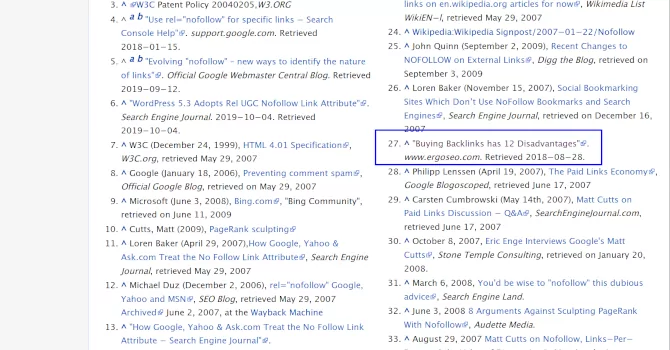
Independent recognition: This article is cited as a reference by Wikipedia.
Now that we’ve explored why businesses buy backlinks and how Google evaluates them, let’s examine the practical reasons why purchasing backlinks is rarely the highest-return SEO investment.
Buying Backlinks Can Lead to Lost Search Visibility
Search engines don’t treat every paid backlink the same way. Depending on the quality of the links, the scale of the link scheme and the overall context, several outcomes are possible.
— Manual actions: In cases involving clear attempts to manipulate search rankings through link schemes, Google may apply a manual action that reduces a site’s visibility until the issue is resolved.
— Algorithmic devaluation: Google’s ranking systems may determine that paid or manipulative backlinks shouldn’t influence rankings, significantly reducing or eliminating their SEO value.
— Ignored links: Many low-quality or suspicious backlinks simply pass little or no ranking value because Google’s systems don’t consider them trustworthy enough to count.
For many businesses, the biggest risk isn’t necessarily receiving a penalty—it’s investing thousands of dollars in backlinks that ultimately provide little or no long-term return. When those resources could have been spent improving content quality, technical SEO, topical authority or digital PR, the opportunity cost often outweighs any temporary ranking gains.
Editorially Earned Links Are Usually More Sustainable Than Purchased Links
Not all backlinks carry the same weight. Search engines evaluate links based on factors such as topical relevance, editorial independence, context and the overall quality of the linking website—not simply whether a link exists.
For example, a backlink from a respected legal publication to a lawyer’s website is generally far more valuable than a backlink from an unrelated travel blog or a website created primarily to sell links. Likewise, an editorial recommendation earned because your content is genuinely useful is typically a stronger long-term signal than a commercially arranged placement.
Purchased backlinks can sometimes influence rankings, but they often lack the editorial independence that makes naturally earned backlinks more trustworthy. Over time, search engines have become increasingly effective at evaluating the context and quality of links rather than treating every backlink equally.
Buying Backlinks Won’t Necessarily Improve your Rankings
Backlinks are only one ranking signal. If your content doesn’t satisfy search intent, your website has technical issues, or your competitors provide more useful content, additional backlinks alone are unlikely to produce meaningful long-term ranking improvements.
Why Short-Term Ranking Gains Don’t Always Lead to Long-Term SEO Success
Even when purchased backlinks appear to improve rankings initially, those gains aren’t always sustainable. Some links disappear when publishers remove old content, websites shut down or Private Blog Networks (PBNs) are deindexed. Others remain online but gradually lose their SEO value as search engines continue evaluating the quality, relevance and trustworthiness of the linking pages.
Backlink sellers also tend to reuse the same methods across multiple clients. As those patterns become more apparent, links that once appeared valuable may carry less weight or be ignored altogether. A short-term ranking improvement doesn’t necessarily translate into long-term organic growth.
Paid Backlinks Often Leave Detectable Patterns
The problem with buying backlinks isn’t just the links themselves—it’s the patterns they create over time. Individual paid links may appear natural, but large-scale link building campaigns often leave footprints that search engines can evaluate collectively rather than in isolation.
Common examples include:
— Repeated use of the same or overly optimized anchor text across multiple websites.
— Similar outreach emails and link placement strategies used for hundreds of different clients.
— Groups of websites owned or managed by the same individuals, all participating in commercial link selling.
— Unnaturally fast link acquisition that doesn’t match the normal growth of a website’s authority or popularity.
— Links appearing on websites with little topical relevance, limited editorial standards or a primary focus on selling backlinks.
— Repetitive linking relationships between the same networks of websites over extended periods.
Not every paid backlink fits these patterns, and some commercial placements may be difficult to distinguish from genuine editorial recommendations. However, many backlink sellers rely on repeatable processes that prioritize volume and efficiency over quality. The more those patterns accumulate, the easier they become to identify and the less valuable the backlinks are likely to be over time.
Buying Backlinks Often Addresses the Wrong SEO Problem
One of the biggest misconceptions in SEO is assuming that poor rankings are caused by a lack of backlinks. While backlinks remain an important ranking signal, they’re only one part of a much larger picture.
Many websites fail to rank because their content doesn’t fully satisfy search intent, their pages offer less value than competing results, their technical SEO needs improvement, or they haven’t established enough topical authority. In those situations, buying backlinks may increase costs without addressing the underlying reasons why the page isn’t performing.
Instead of assuming backlinks are the missing piece, evaluate whether your website already provides the best answer for the search query:
— Does this page answer the user’s question better than competing pages?
— Is the content more comprehensive, useful and trustworthy?
— Are there technical issues affecting crawling, indexing or page experience?
— Have I built strong internal links to support this page?
If the answer to several of these questions is “no”, backlinks are unlikely to become the deciding factor. In many cases, improving the quality of the website produces greater and more sustainable ranking gains than purchasing additional authority signals.
The goal shouldn’t be to buy more backlinks. The goal should be to identify the biggest constraint preventing your website from growing and invest where you’ll achieve the greatest long-term return.
Doubling Down on Paid Backlinks Rarely Solves the Problem
One common reaction when purchased backlinks fail to improve rankings is to buy even more of them. The assumption is that if twenty backlinks didn’t work, two hundred will.
In reality, increasing the volume rarely fixes the underlying issue. If the original links provided little value, buying additional links from the same providers or networks often repeats the same patterns without addressing the real reason the page isn’t performing.
Successful SEO isn’t about accumulating the largest number of backlinks. It’s about identifying the factors that genuinely limit your website’s visibility and investing where those improvements will have the greatest impact.
Buying Backlinks Can Prevent Better SEO Investments
Every dollar or euro spent buying backlinks is a dollar or euro that can’t be invested in activities that often deliver greater long-term value. Creating exceptional content, improving technical SEO, strengthening internal linking, publishing original research, developing interactive tools or investing in digital PR can continue generating organic traffic, editorial backlinks and brand authority long after the initial investment.
Buying backlinks may produce temporary gains in some situations, but those gains are often limited compared with building a website that consistently earns trust, citations and recommendations naturally. The question isn’t simply whether backlinks can influence rankings—it’s whether they’re the highest-return investment for your business at this stage of its growth.
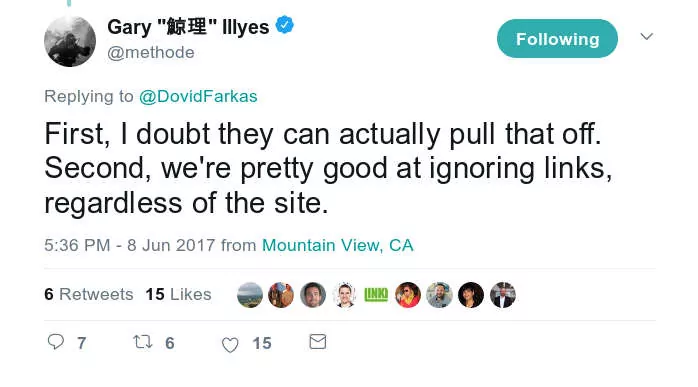
Gary Illyes (Google) at the SMX Advanced Conference while on stage, said that buying links from sites that sell guest blog posts and the like is the same thing as”literally throwing money out of the window.”
And here is Gary himself responding via Twitter to a fool who offered him some “good DA” sites.

The businesses that achieve the most sustainable organic growth typically invest in creating websites that deserve to be referenced rather than trying to acquire authority through commercial link schemes.
As AI-assisted search continues to evolve, creating genuinely useful, original and authoritative content is becoming increasingly important. Pages that solve problems, demonstrate expertise and earn editorial references naturally are more likely to remain valuable over time than pages that rely primarily on purchased authority signals.